
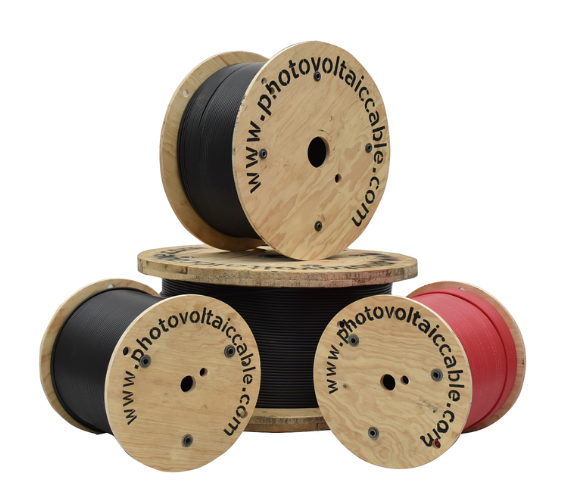
When designing or upgrading a solar installation, choosing the correct photovoltaic cable voltage rating plays a critical role in system safety, efficiency, and long-term reliability. Modern solar installations increasingly operate at higher voltages — and installers are making the switch from 600V PV wire to 2000V PV wire for good reason.
Below are the five main advantages of 2000V photovoltaic cable compared to 600V, and a practical guide on when to use each.
Contents
1. Higher System Voltage Capability
Modern solar arrays — especially commercial and utility-scale systems — operate at higher DC voltages to reduce current and improve overall efficiency. String configurations paired with 1000V and 1500V DC inverters require cable rated well above 600V to maintain a proper safety margin.
2000V PV wire supports these modern architectures while providing an additional safety buffer. In contrast, 600V cable is only appropriate for small residential systems or legacy installations operating below that threshold.
2. Increased Efficiency and Reduced Power Loss
Higher system voltage allows solar arrays to operate with lower electrical current for the same power output. Lower current means lower resistive losses (I²R losses) along cable runs — real energy that would otherwise be lost as heat.
Higher-voltage systems also allow installers to:
- Use longer string lengths — fewer strings to wire per array
- Reduce the number of parallel connections — fewer combiner boxes
- Lower Balance of System (BOS) costs — less conduit, fewer terminations, faster installation
3. Greater Safety Margin and Insulation Strength
2000V PV wire uses advanced insulation compounds — typically cross-linked polyethylene (XLPE) — engineered to withstand the extreme conditions of outdoor photovoltaic installations for 25+ years.
Compared to standard 600V cable, 2000V-rated wire provides:
- Higher dielectric strength — withstands voltage spikes and transients common in PV systems
- Superior thermal endurance — rated to 90°C wet, 150°C dry
- Excellent UV and ozone resistance — 720+ hours of UV exposure per UL4703
- Reliable performance at extreme temperatures — from −40°C to +90°C
4. Simplified Solar System Design
High-voltage solar systems require fewer parallel circuits to deliver the same power. This directly simplifies system architecture and reduces the total bill of materials.
2000V PV cables help reduce:
- Total cable runs — less wire to purchase, pull, and terminate
- Junction and combiner boxes — fewer connection points
- Installation time — fewer circuits to commission and inspect
- Long-term maintenance — fewer potential failure points over 25 years
5. Future-Proof Solar Installations
The solar industry continues to move toward 1000V and 1500V DC system standards. Selecting 2000V-rated photovoltaic cable ensures compatibility with next-generation inverters and complies with international standards including:
- UL 4703 — US standard for photovoltaic wire
- IEC 62930 — international PV cable standard
- TÜV photovoltaic cable standards — European certification
Installers and project developers who specify 2000V wire today protect their investment against future code changes and technology upgrades — without needing to re-wire.
When to Choose Each Cable Type
| System Type | Recommended Cable | Voltage Rating |
|---|---|---|
| Residential / small rooftop systems | PV Wire 600V | Up to 600V DC |
| New residential systems (post-2020) | PV Wire 2000V | Up to 1000V DC |
| Commercial & industrial systems | PV Wire 2000V | Up to 1500V DC |
| Utility-scale solar farms | PV Wire 2000V | Up to 2000V DC |
| Replacement in existing 600V system | PV Wire 600V | Match existing rating |
Conclusion
Using 2000V photovoltaic cable offers clear advantages over 600V PV wire: higher electrical efficiency, superior insulation durability, simplified system design, and compatibility with modern and future solar standards.
For any new commercial, industrial, or utility-scale installation — and for most new residential systems designed today — 2000V solar cable is the right specification. The 600V option remains valid only for replacement work in existing legacy systems.
UL4703 Copper PV Wire 2000V — In Stock
6, 8, 10 & 12 AWG · Red and Black · 500 to 5,000 ft reels · Ships same or next business day from TX & CA.
Browse 2000V PV Wire →Not sure which gauge you need?
Use our free Voltage Loss Calculator — enter your string current, cable length and AWG to get an instant result.
Open Voltage Loss Calculator →